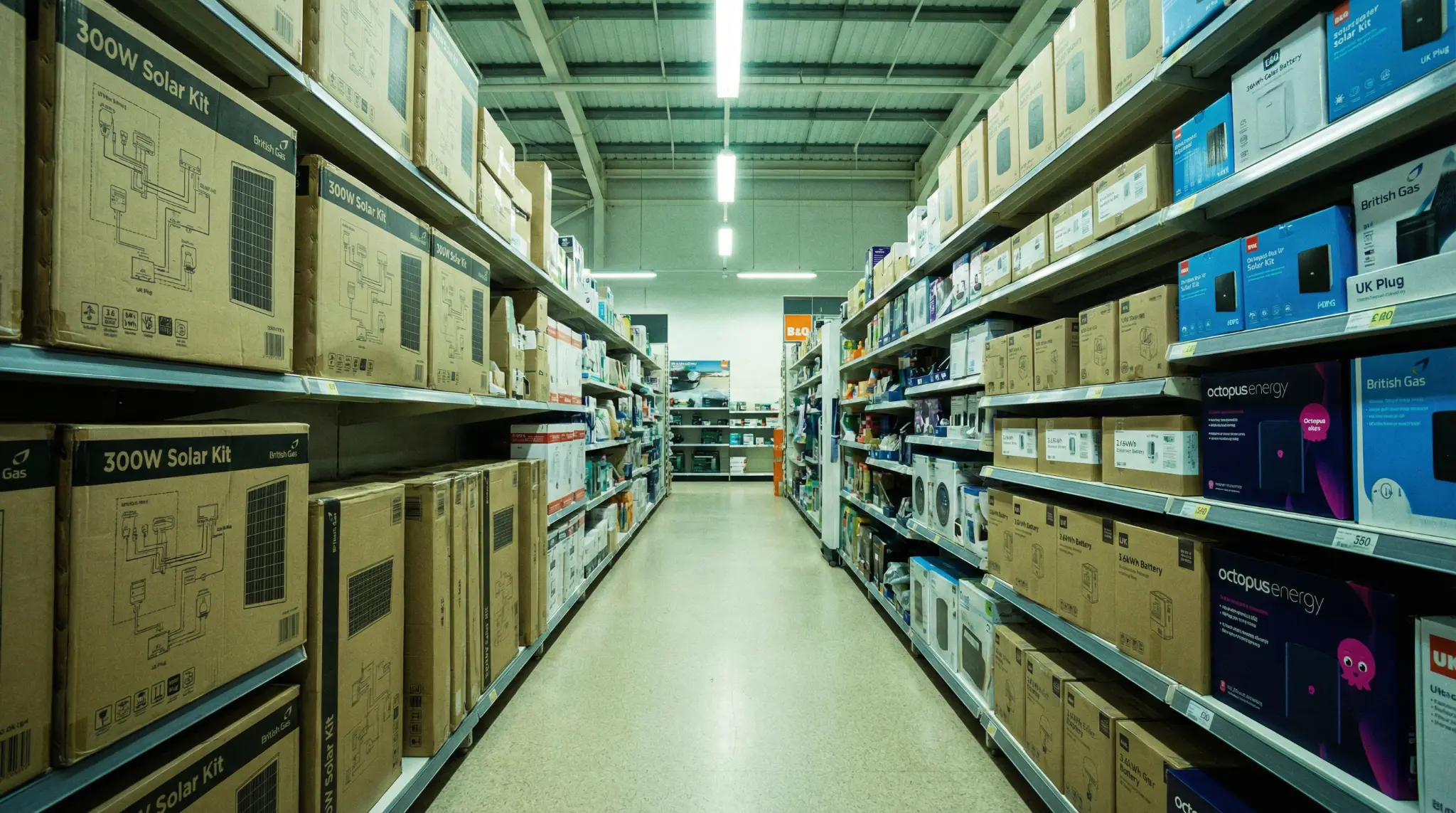
Tesco, Asda and Aldi are now selling solar panel packages. It sounds convenient — but independent assessors are seeing the consequences. Here's what the supermarkets won't tell you.
A New Trend With Old Problems
In 2024 and 2025, several major UK supermarkets began offering solar panel packages at point of sale — prominently displayed near the checkout, in catalogues, or through dedicated online portals. Aldi's solar panel offers routinely sell out within hours. Tesco and Asda have followed with bundled energy packages.
On the surface, it seems like good news: solar going mainstream, prices falling, accessibility improving. But independent surveyors across the UK are beginning to see what happens after the panels go up — and the picture isn't pretty.
The Problem Isn't the Panels. It's the Process.
Supermarket solar packages are designed around convenience and price. That means critical steps get skipped:
- No independent roof assessment. Is your roof structurally sound? Does it face the right direction? What's the pitch? These questions determine whether solar is viable at all — and no supermarket leaflet can answer them.
- No shading analysis. A neighbour's extension, a chimney stack, nearby trees — even partial shading can reduce solar output by 30–50% on certain panel configurations. Without a proper survey, you won't know until your bills don't drop.
- One-size-fits-all system design. Your energy consumption pattern is unique. Peak usage times, appliance load, whether battery storage makes sense — none of this is factored into a bundled retail package.
- No genuine financial modelling. Supermarkets quote average savings. Your home's actual savings depend on your orientation, shading, consumption, grid tariff, and export rate. Averages can be misleading by thousands of pounds.
Who Actually Installs It?
Supermarket solar packages are typically fulfilled through third-party installation networks — subcontractors sourced regionally, often under time pressure to complete jobs quickly. This creates quality control risks:
- Installers may not be MCS-certified for the specific products used.
- Workmanship warranties may not be backed by the installer's own insurance.
- If the installer goes out of business, your warranty claim falls to the supermarket — which has no obligation to guarantee third-party work.
- Roof penetrations made without proper flashing or sealant are one of the most common causes of post-installation damp.
We have assessed properties where supermarket-sourced installations have created more problems than they solved — misaligned panels, inverters installed in unsuitable locations, and consumers left without the MCS certification needed to access export tariffs.
The MCS Certificate Problem
To access the Smart Export Guarantee (SEG) — the scheme that pays you for electricity you export to the grid — your installation must be MCS-certified. Without this certificate, you generate electricity you can't be paid for.
Supermarket installations frequently fail to provide correct MCS documentation, or the documentation is incomplete. Consumers often don't discover this until they try to register with an energy supplier and are turned away.
Correcting this retrospectively can be costly — and sometimes impossible if the original installer is no longer trading.
Bundled Finance: Read the Small Print
Many supermarket solar offers are bundled with financing — 0% credit offers, monthly payment plans, or buy-now-pay-later arrangements. These are consumer credit products regulated by the FCA. What to watch for:
- Deferred interest: Some 0% offers revert to high APR if not fully paid within a set period.
- Secured lending: Some installers offer loans secured against your property. Defaulting carries serious consequences.
- Early repayment charges: May apply if you remortgage or sell your home.
- Insurance obligations: Loan terms may require specific home insurance which can be more expensive than your current policy.
An independent assessor reviews all financial projections and financing arrangements before you commit. A supermarket does not.
What Independent Assessment Looks Like
Before recommending solar to any client, KyTherma Logic conducts:
- Roof condition and structural assessment — load-bearing capacity, age of covering, condition of felt and battens.
- Orientation and pitch analysis — satellite and on-site review of angle, aspect, and shading profile throughout the year.
- Energy consumption profiling — real usage data to size the system correctly and determine whether battery storage adds value.
- Financial modelling — actual projected generation, SEG income at current rates, payback period, and net present value over 25 years.
- Installer vetting — we only recommend MCS-registered installers with verifiable track records and appropriate insurance.
This process takes time. It costs money. But it's the difference between a system that performs as promised and one that disappoints for 25 years.
The Bottom Line
Solar panels are a 25-year commitment to your property. They affect your roof, your electricity bills, your mortgage (remortgaging lenders increasingly check for MCS certification), and the value of your home.
Buying solar panels from a supermarket is like buying a structural extension from a flatpack catalogue. The price looks right. The pictures look good. But the details that determine whether it works for your specific home aren't on the label.
Get independent advice first. Always.
supermarket solar solar panels UK solar scams independent advice ECO4 solar installation
K
Independent Home Energy Assessor at KyTherma Logic Ltd — nearly 2 decades of experience helping UK homeowners make confident, evidence-based energy decisions.